Trauma and Somatics

35-HOUR CERTIFICATION PROGRAM

You're already working
with trauma. You just
don't know it.

Over 70% of humanity is living
with the impact of trauma.

Clients won't always tell you they've experienced trauma. But their bodies will show you the signs. Learn to see what others miss and respond with greater skill and care. This training elevates the work you already do and deepens the impact you can have.

Trusted by:

  • Soltara
  • SHERPA breath and cold
  • Lauren Zoeller
  • Embodymind
  • soma+IQ Breathwork
  • Ruby Fremon

WHY THIS TRAINING MATTERS

"The ONLY Training that teaches the principle beneath all Somatic practices."

This 12-Week Training will completely change your life.You'll learn to Embody Trauma-Informed Somatic Skillsso that your clients finally get the results they need.

Core Skills You'll Master

Trauma affects 5 Billion people. These skills are non-negotiable.

As someone who’s committed to serving people at the highest level – trauma informed skills are essential.

  • Track the Nervous System

    Spot the signs and symptoms of trauma in your client’s bodies. The greatest foundational skill you can master to get your clients results.

  • Apply Somatic Techniques

    Help clients regulate in real-time. Use somatic techniques to build resilience and improve outcomes. Know exactly what to do when things get difficult.

  • Master Trauma-Informed Care

    The body and mind can only change when the nervous system senses 'safety.' Create safer spaces so that your clients can actually change.

Student Testimonials

More than a training

Hear what graduates are saying about their experience in the Trauma and Somatics training.

Who Is This For

Built for Practitioners Like You

  • Coaches

    Go beyond surface coaching. See what's beneath client "stuckness" and gain somatic tools that help create deeper, more lasting breakthroughs.

  • Therapists

    Enhance clinical skills with practical, body-based methods rooted in Polyvagal Theory to support nervous system regulation and trauma integration.

  • Bodyworkers

    Learn to read the body's trauma cues, recognize what the body is communicating, and create the safety needed for deeper integration.

  • Psychedelic Facilitators

    Learn to meet intense nervous system states with greater skill, helping clients feel safer through preparation and integration.

  • Health Coaches

    Address how unresolved trauma impacts your client’s physical health goals. Understand how lived experience affects the body, behavior, and resilience so you can support deeper change.

  • Breathwork Practitioners

    Deepen your understanding of breath, trauma, and the nervous system. Facilitate deeper, more integrated experiences to create better, lasting results with clients.

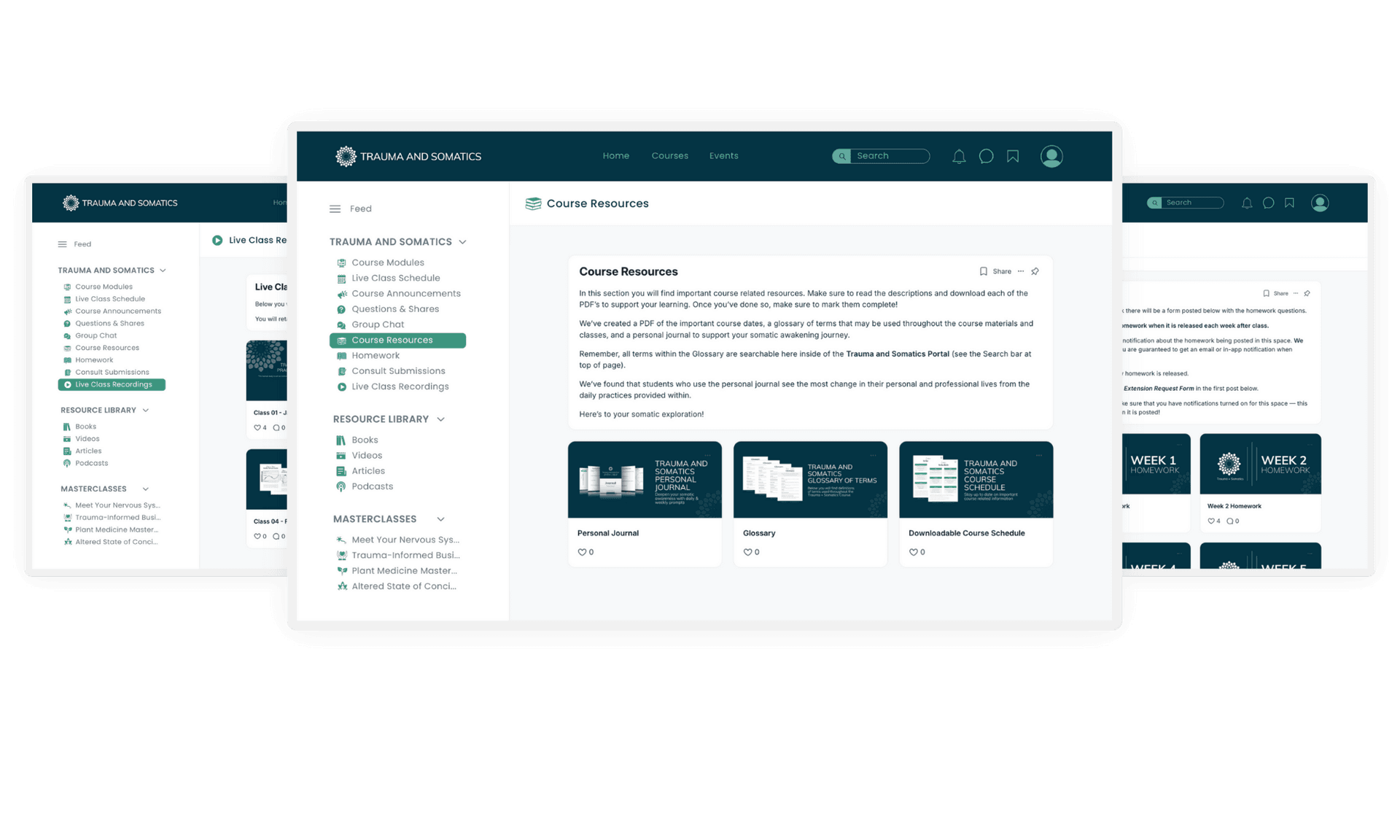
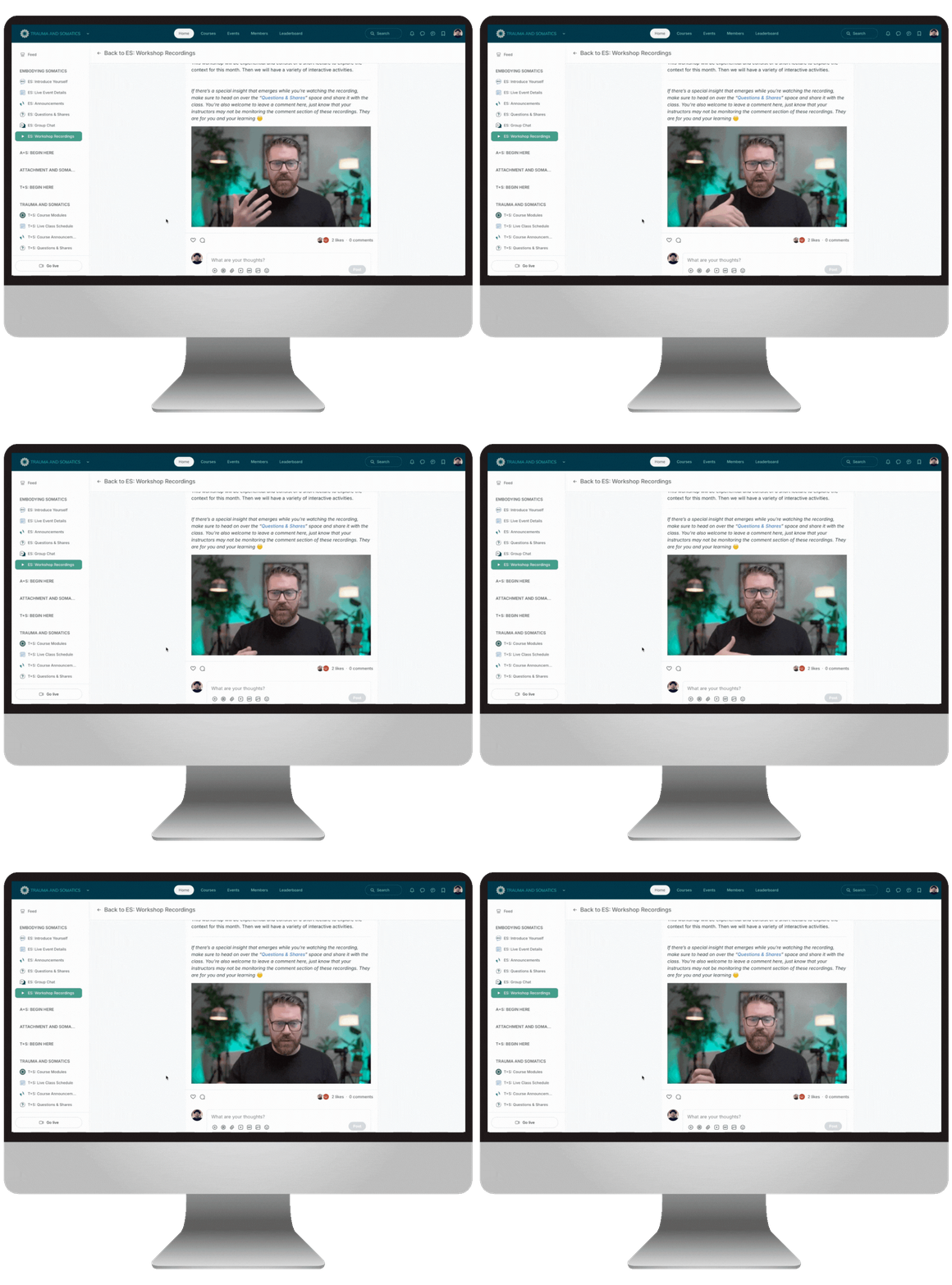
The Trauma and Somatics course portal

Become Part of the Global Solution

Join 550+ practitioners across 28 countries building a global network in a supportive network dedicated to trauma-informed care. Connect, grow, and collaborate with people who believe the way we show up for one another can change the world. The world needs your skilled, compassionate presence.

Impact at a Glance

Training Outcomes: By the Numbers

  • 70%

    of adults face trauma. Your skills are critical.

  • 50%

    drop in PTSD symptoms with somatic therapy (Somatic Experiencing Study).

  • 23%

    rise in client retention with trauma-informed care (Practitioner Survey).

  • 20%

    of therapists feel equipped for trauma. Our training fixes that.

Our Integrative Approach

Tools & Frameworks You'll Master

This training doesn't just teach theory; it equips you with practical, evidence-informed tools and frameworks rooted in somatic wisdom and neuroscience. You'll learn to integrate these powerful approaches:

  1. Polyvagal Theory Application:

    Go beyond textbook knowledge. Learn to apply Polyvagal Theory practically to track nervous system states, foster safety (Ventral Vagal), and navigate activation (Sympathetic) or shutdown (Dorsal Vagal) effectively in sessions.

  2. Somatic Awareness Practices:

    Master techniques to guide clients (and yourself) into the body's "felt sense," increasing capacity to process sensations and emotions directly without bypassing.

  3. Nervous System Tracking:

    Develop keen observational skills to read the subtle language of the body – breath patterns, posture shifts, micro-expressions – understanding what they reveal about underlying states.

  4. Window of Tolerance Navigation:

    Learn to gently assess client capacity, work effectively within their tolerance for stress, and use tools to expand it over time, preventing overwhelm.

  5. Resourcing & Resilience Building:

    Help clients identify unique internal and external resources. Co-create personalized "Resilience Routines" that build nervous system flexibility and capacity day-to-day.

  6. Ethical Frameworks & Scope:

    Practice within clear ethical guidelines. Master consent conversations, navigate power dynamics consciously, and know precisely when and how to refer out.

  7. Trauma-Sensitive Container Creation:

    Learn the art of setting agreements, structuring sessions, and using language that fosters physiological safety, inclusivity, and trust from the start.

  8. Embodied Mentorship:

    Receive personalized feedback and guidance in intimate small groups, helping you integrate complex skills directly into your practice with confidence.

  9. Co-Regulation Skills:

    Become a regulating presence for your clients by understanding attachment dynamics and utilizing your own centered nervous system to create safety in connection.

Whats Included

Your Journey at a Glance

This comprehensive training guides you step-by-step from foundational understanding to embodied application. Each module builds upon the last, empowering you to confidently and ethically support clients through trauma.

  1. Module 1

    Foundations

    Build your base by understanding the prevalence of trauma, defining it through a somatic lens (response, not event), exploring core somatic principles (body-mind unity), and clarifying practitioner roles (aware vs. informed vs. centered). Establish the pillars of Safety, Belonging, and Dignity.

  2. Module 2

    Nervous System Deep Dive

    Master the language of the ANS. Learn Polyvagal Theory essentials (Ventral Vagal, Sympathetic, Dorsal Vagal) and the 4 Survival Responses (Fight, Flight, Freeze, Fawn). Understand Neuroception (unconscious safety detection) and the power of Co-regulation.

  3. Module 3

    Practitioner Tools I - Awareness

    Develop crucial observational skills. Learn sophisticated nervous system Tracking, cultivate practitioner Attunement, utilize the Window of Tolerance model for assessment, and navigate Consent, Power Dynamics, Attachment, and Projection ethically.

  4. Module 4

    Practitioner Tools II - Action

    Build your toolkit for active support. Master Resourcing (identifying strengths), Regulation techniques (Grounding, Self-Contact, Orienting), Resilience building practices, and learn to use Empathic Statements effectively.

  5. Module 5

    Ethical Practice & Containers

    Define your professional Scope of Practice. Learn to create Trauma-Sensitive Containers (structure, agreements, inclusivity). Address Diversity, Equity & Inclusion (DEI) awareness and practice skillful Rupture Repair.

  6. Module 6

    Embodiment & Integration

    Prioritize your own nervous system health as your primary tool. Implement self-care routines, utilize Polyvagal Mapping for self-discovery, and integrate all course learnings into an embodied, confident professional presence.

Testimonials

What Our Students Are Saying

Will & Aurianna create the safest space for students to be their whole selves... I felt very validated and supported... It was incredible to deepen my knowledge surrounding our nervous system... honor the knowing of my system in a new way.
Noelle & Molly
This program contains information that every single person (and especially helping professionals) need to know... Trauma and Somatics was the MISSING PIECE to helping me to understand how to do this deep work with better results...
Taylor LouImage Consultant + Business Mentor
Before this course, I doubted my ability to handle trauma... I can now more confidently lean in to holding space for others because I deeply trust my capacity to be with any trauma responses and I know what to do when activation occurs.

Carly MooreCreator at Meraki Life
I never thought I could be so profoundly changed by a 35-hour course... There is enough theory on the internet; we truly need embodiment... Undoubtedly, this course was a turning point in my life.
Lucas LimaSelf-Development Teacher
My language has transformed and I have a much deeper, empathetic understanding... If your goal is to effect aligned, safe, and considerable change in your clients, going through this program is an absolute must.
Alexa BowditchSex Coach + Business Mentor

Pricing Plans

Flexible Payment Plans

  • 3-Part Payment

    Most popular

    $1,100

    Monthly x 3

    • BONUS #1: Earn a Certificate of Completion

    • BONUS #2: Printable Personal Journal

    • BONUS #3: Private Community Access

  • Single Payment

    *Most affordable

    $3,000

    One-time fee

    • BONUS #1: Earn a Certificate of Completion

    • BONUS #2: Printable Personal Journal

    • BONUS #3: Private Community Access

Bonuses

Join Us and Receive

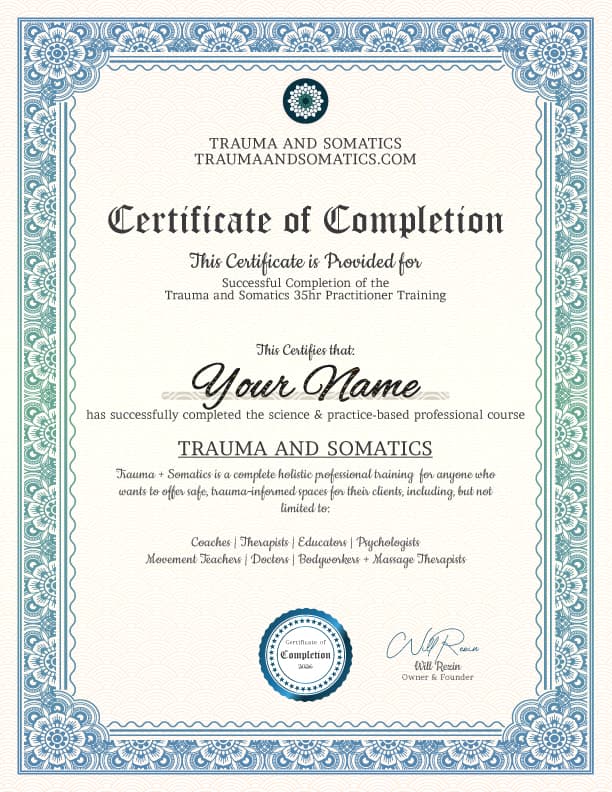
Bonus #1: Certificate of Completion

Complete the journey, and you'll receive a printable digital Trauma + Somatics Certificate of Completion.

More than a certificate, it's a marker of the time you've invested in learning to understand, see, and support human beings in a deeper way.

The Trauma and Somatics Certificate of Completion
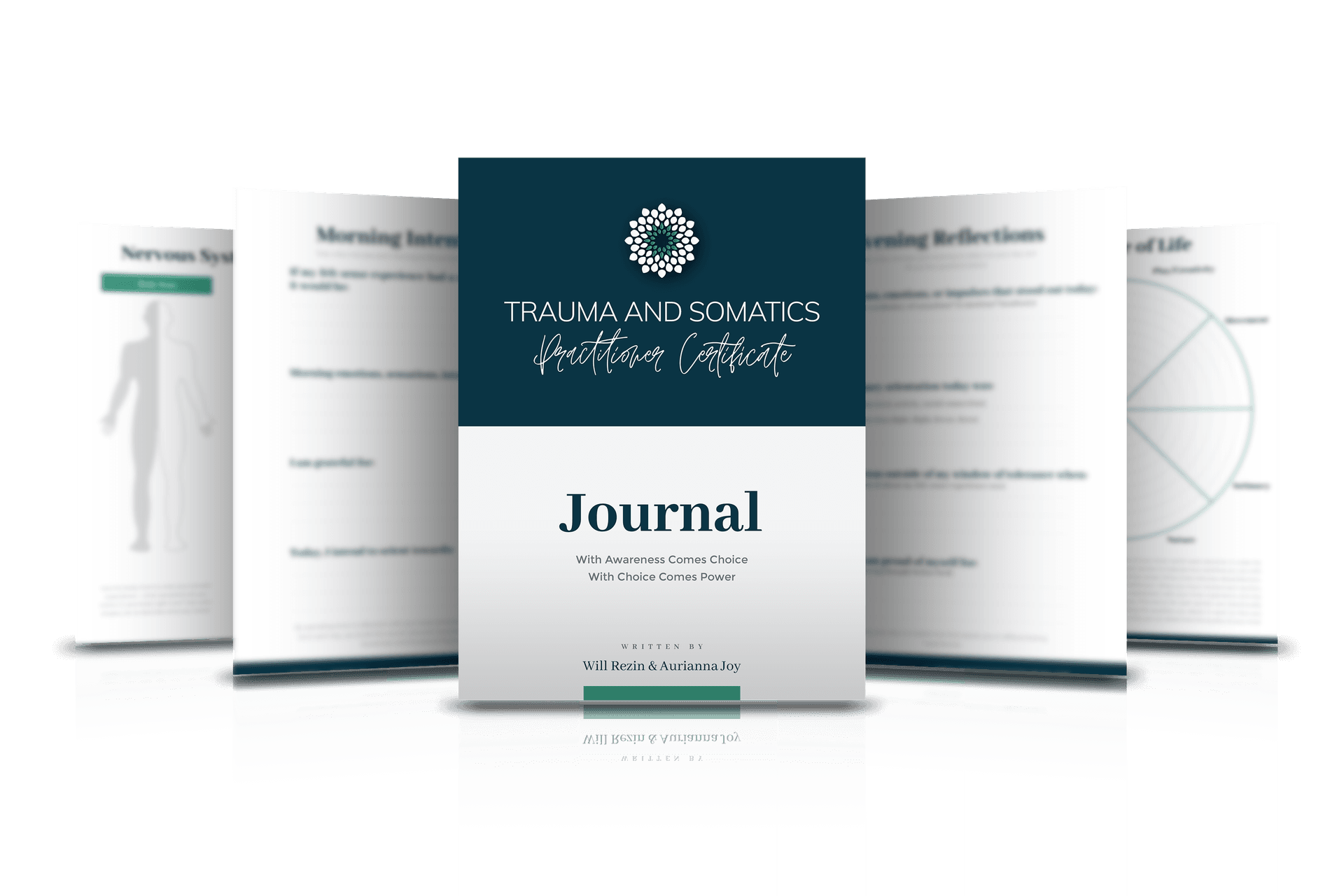
The Trauma and Somatics personal journal

Bonus #2: Personal Journal

What you notice changes you.

You'll receive a printable personal journal to track your progress, deepen somatic awareness, and stay connected to what you're discovering in your own body.

Bonus #3: The Collective Membership

Join monthly workshops that blend movement, mindfulness, and community to reduce stress, deepen self-awareness, and foster transformation. This is your place to experience somatics.

A Somara Collective workshop on screen
The Trauma and Somatics personal journal

Bonus #4: Build Your Somatic Practice

Learn the work. Then learn how to build a thriving practice around it.

Join a live business series covering positioning, pricing, referrals, and how to clearly communicate what you do.

Training Logistics

Your Journey at a Glance

Live Classes

Tuesdays via Zoom.

12 – 3pm PT / 2 – 5pm CT / 3 – 6pm ET

Click here to check your local Time Zone.

All live classes are recorded and students will retain lifetime access to all course materials.

Self-Paced Modules

There are 6 self-study modules released bi-weekly on Sundays throughout the training. Each module contains audio lessons, guided somatic meditations, and full-color workbooks.

Homework + Reading

Homework will be due weekly to enhance your learning experience. Homework submissions are required to receive your Certificate of Completion. There is also one book that is required to read during the training.

Certificate Requirements

To receive your certificate of completion, you must meet the following requirements:

  • Attend every class live or watch the recordings
  • Complete the weekly homework (given at the end of each live class)
  • Complete the self-study modules
  • Submit your Homework + Attendance documentation every Monday
  • Receive 85% or higher on the end of course quiz

Upcoming Class Dates & Times

  • SEptember 25th - december 18th, 2026

  • Tuesdays, 3:00pm - 6:00pm U.S. Eastern

00

Days

00

Hrs

00

Mins

00

Secs

Your Trainers

Guided with Care

  • Will Rezin

    Will Rezin

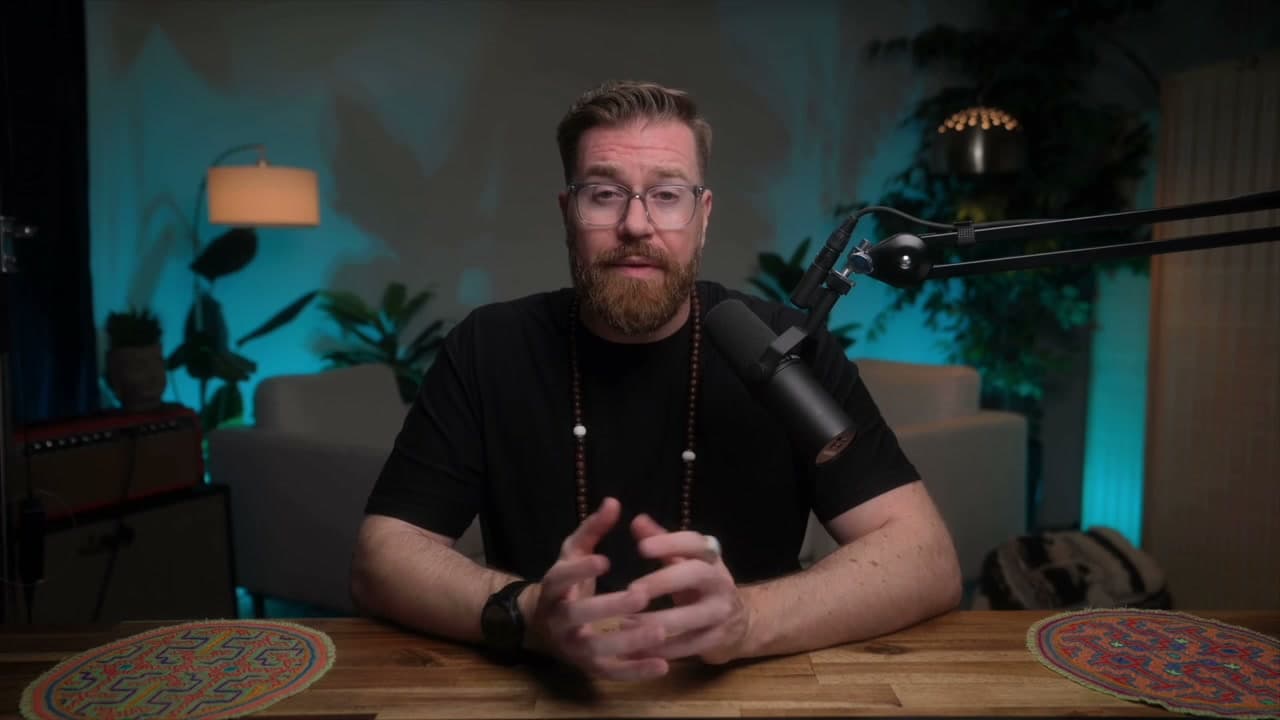
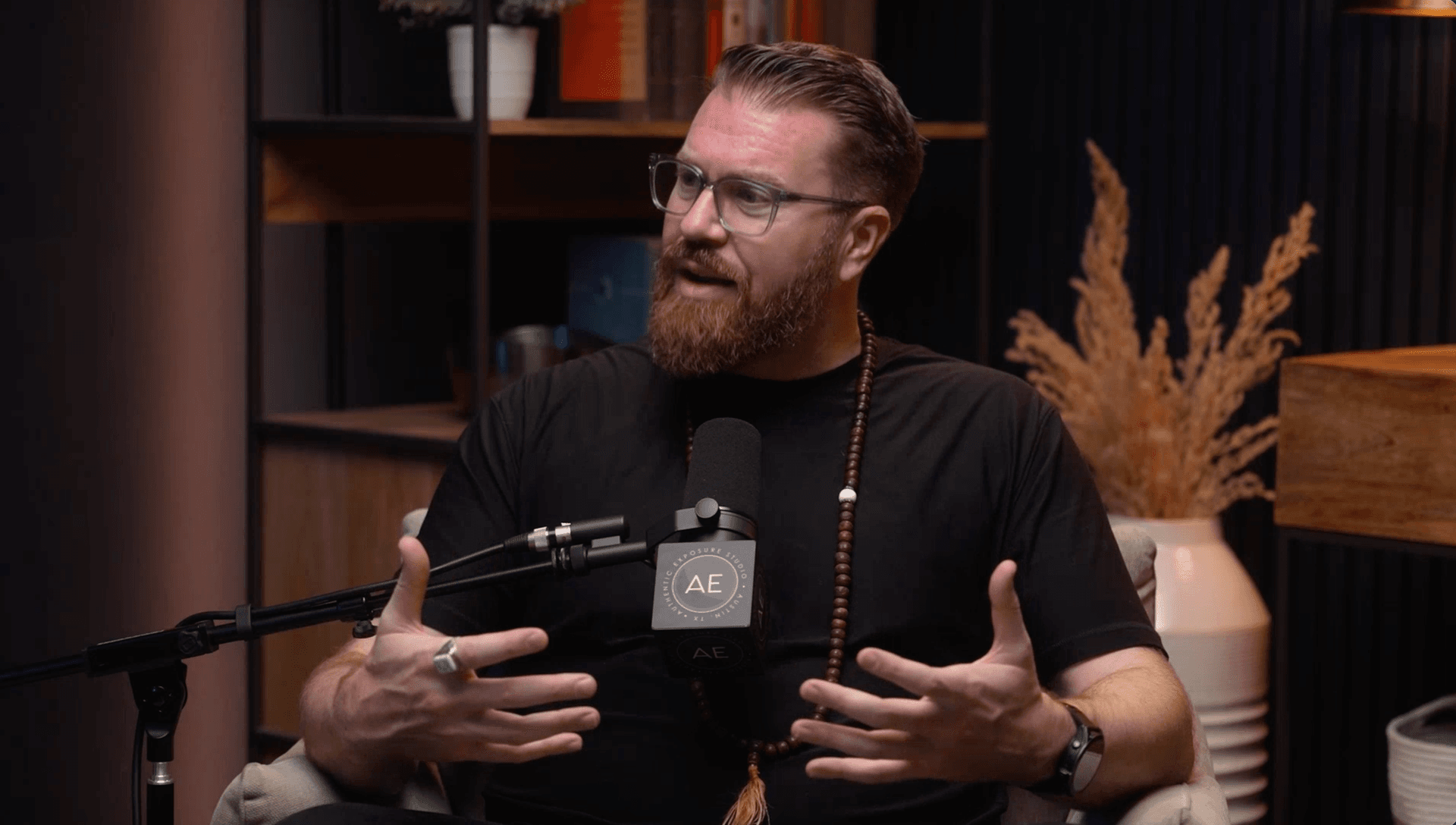
    Will Rezin is a Somatic Experiencing Practitioner and the founder of Trauma and Somatics, a global training organization dedicated to advancing professional practice in trauma recovery and attachment repair through embodied, capacity-building approaches.

    Since 2020, Will has trained over 500 practitioners across 28 countries through live cohort-based certificate programs. His work synthesizes insights from multiple somatic lineages including Stanley Keleman’s Formative Psychology, Ron Kurtz’s Hakomi, Peter Levine’s Somatic Experiencing, Raja Selvam’s Integral Somatic Psychology, and contemporary attachment neuroscience.

    Will holds over 350 hours of training and supervision in Somatic Experiencing and has served as a training assistant for SE International. He is a certified professional coach and maintains an active clinical practice alongside his teaching.

    Currently, Will is developing Formative Somatics©, a comprehensive methodology integrating somatic trauma recovery with attachment-focused relational work, in collaboration with Kate Appleton, LPC.

  • Geoff Cox

    Geoff Cox

    Geoff Cox is a leadership and embodiment coach, conflict mediator, somatic trauma bodyworker, and meditation teacher. He teaches at the University of Virginia and integrates multiple modalities including Somatic Experiencing, parts work, hospice care, and Qi Gong.

    His work bridges contemplative practice with trauma-informed somatic work, bringing a grounded, masculine presence to the training space. Geoff specializes in helping practitioners develop their own embodied regulation as a foundation for clinical work.

  • Natasha Pampin

    Natasha Pampin

    Natasha Pampin is an Argentine-American trauma-trained Mental Health and Somatic Experiencing Practitioner based in New York City. She co-founded an environmental NGO and brings a unique cross-cultural lens to somatic work.

    Her training integrates ontological coaching, focusing, and mindfulness practices. Natasha brings warmth, precision, and deep cultural awareness to her teaching on nervous system regulation and trauma recovery.

We’ve Got Answers

Frequently Asked Questions

  • While this program is designed for helping professionals who are actively working with clients, caring humans of any kind are welcome to join.

  • This training is currently 100% virtual. There will be 10 live classes hosted through Zoom.us (Tuesday’s at 3pm ET) and 5+ hours of pre-recorded learning material released bi-weekly. You will also be given additional integration options, including weekly homework, personal journaling, and reading/video resources.

  • Trauma and Somatics is a live 12-week training program that takes place from January 16th – April 10th, 2026.

  • Yes! We run three virtual trainings each year, beginning in January, May, and September, If you would like to register early for an upcoming training, please send us an email here.

  • The investment for the all-inclusive live 3-month training certificate is $3,000 USD when paid in full, or three monthly payments of $1,100 USD. Please note we cannot accommodate exchange rate differences if you are outside the US. To apply for financial aid or learn more about our scholarship options, please see our financial aid page here.

  • The ten live training classes are held via Zoom on Tuesday’s from 3:00 pm – 6:00 pm Eastern US (check your local time zone here). The live class dates for the upcoming cohort are: 1/20, 1/27, 2/3, 2/10, 2/24, 3/3, 3/10, 3/24, 3/31, 4/7

  • Due to the emergent and experiential nature of somatic work, we have included 10 live virtual classes in addition to the 6 self-study modules. These classes will include interactive skills-based learning sessions, live exercise demos, Q+A, supervision, and more.

  • Live attendance of the interactive classes is highly recommended for you to benefit fully from the course.

  • We suggest committing at least 4-hours a week to the training to listen to the modules, practice the somatic exercises you will learn, attend/watch the live classes, and do your daily journaling.

  • This is a group training program, so all contact and support will be within the live classes and the private online community space. However, you will have plenty of opportunities to interact with your teachers and receive personalized support.

  • Trauma and Somatics is a professional training organization, and, as such, is not focused on personal healing. If you are interested in working with a trauma-trained professional, we recommend visiting the Somatic Experiencing® Practitioner Directory and finding a Somatic Experiencing® Practitioner in your local area. If you are interested in working with one of our facilitators, we have a waiting list that you may request to be added to by sending us an email here.

  • No, while this course is focused primarily on professional development, there is currently no industry-standard trauma-informed certification. We do however take this work seriously and encourage our students to complete the entire program by offering a Certificate of Completion.

  • CEU’s are not available at this time.

  • Yes! For each cohort, we offer a handful of 25% and 50% financial aid, with payment plan options. We also offer financial aid for individuals from developing countries. If you would like to apply for financial aid, please apply here . You will be added to the scholarship waitlist and receive an email with more details as soon as the application process is open.

  • Please visit our Cancellation and Refund Policy page.

  • Send us a message here and we will gladly answer any questions you have.

Disclaimer

To promote good professional practice, you are advised to use this training within the boundaries of your professional expertise and scope of practice. While Trauma and Somatics provides the knowledge of stress and trauma physiology, it is designed as a continuing education training and is therefore not a substitute for a professional training program, such as a coaching certification, massage therapy training program, psychology degree, doctoral program, etc. We recommend you receive foundational training in your chosen area of professional development before joining the program.

Trauma and Somatics is not a substitute for medical or psychological services of any kind. The information provided inside the course is meant for educational purposes only and is not intended to treat, diagnose, prevent, or cure disease. By joining the program, you are affirming that you are emotionally stable, in sound psychological health, and personally responsible for all of your own decisions and commitments. The founders of Trauma and Somatics are not responsible for any decisions made as a result of the training program.